Dubai South real estate: how to think about the investment
Not a list of properties. A framework for deciding whether Dubai South fits your strategy in 2026, the real ROI, the airport timeline that drives everything, and the one number most buyers get wrong.

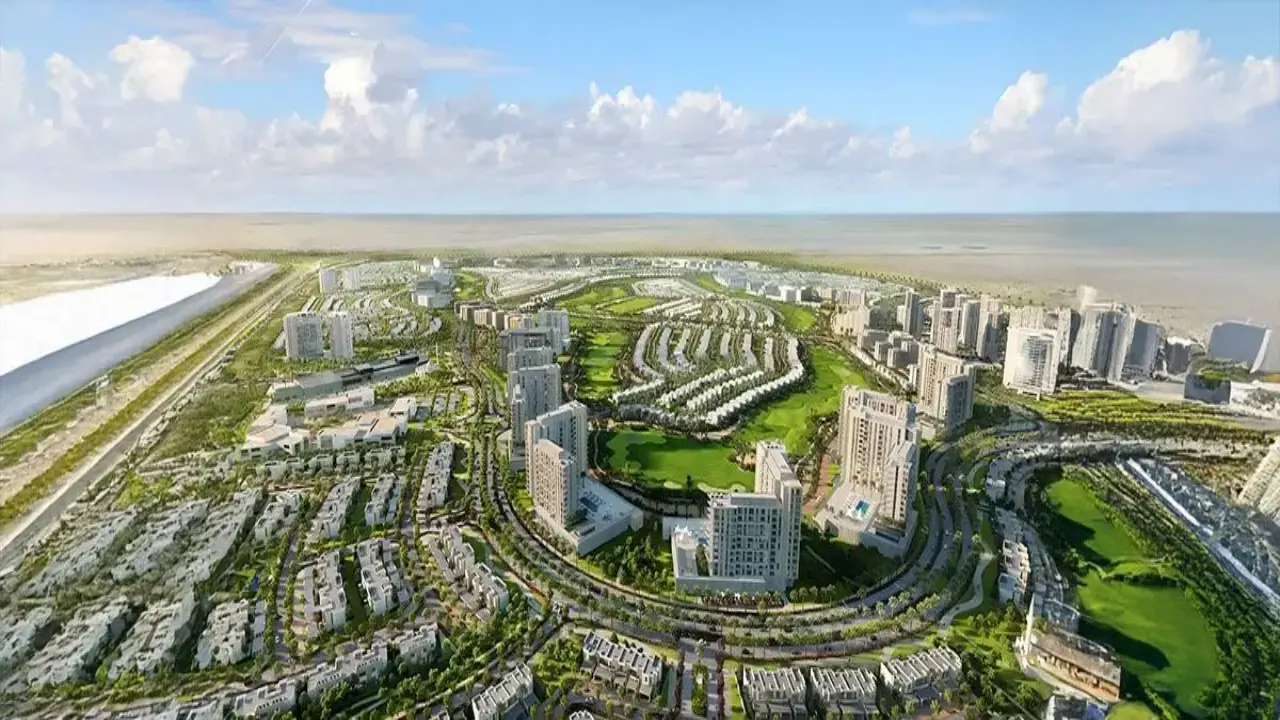
Everyone now agrees Dubai South is where the smart money is going. When everyone agrees on something in property, that is exactly the moment to slow down and check the maths. So this Dubai South real estate guide is not a pitch for the area. It is a framework for working out whether it fits your strategy, and an honest look at the numbers behind the headlines.
Dubai South is a master-planned district around Al Maktoum International Airport and Expo City. If you want the area basics first, the Dubai South area guide covers the communities and the location. This page is about the investment case: the ROI, the risks, the timeline, and how to decide.
The Dubai South investment case in numbers
Start with the data, because the case rests on it. These are 2026 market figures, directional, to be confirmed against live data before you act.
The core of the thesis is the roughly 35 billion dollar expansion of Al Maktoum International Airport, set to become one of the largest airports in the world. Around it, transaction volumes have accelerated sharply, and the average price per square foot across Dubai South, near AED 800 in early 2026, sits far below the Dubai citywide average. Lower entry, rising demand, infrastructure-led. That is the case in one line. The rest of this guide is the scrutiny that line deserves.
Is Dubai South a good investment? The honest answer
It depends entirely on your time horizon, and anyone who answers without asking yours is selling. Dubai South is a strong investment for one kind of buyer and a poor one for another. The airport's first operational phase is targeted for the early 2030s, with full capacity stretching toward the 2040s. That is the clock the whole capital-growth case runs on.
So if you are buying to hold for 5 to 10 years, you are buying at relative value ahead of the infrastructure delivering, which is the right side of the trade. If you are buying to flip inside two years, you are betting on short-term sentiment in a district whose payoff is a decade out, which is the wrong side. Same area, opposite verdict, decided entirely by horizon.
The one number most buyers get wrong: net vs gross yield
Here is the single most important thing in this guide. The 6 to 8 percent yield you see quoted everywhere is gross, and gross yield is a vanity number. It is annual rent divided by price, before any of the costs that actually come out of your pocket.
The number that matters is net ROI: annual rent minus service charges, minus maintenance, minus a realistic vacancy allowance, divided by your total purchase cost including transaction fees. On a typical Dubai South apartment, that calculation lands roughly one to two points below the gross figure, often around 7 percent net on a well-chosen unit, which is genuinely healthy. But you must run it yourself on the specific property. A high gross yield with heavy service charges can net out to something ordinary. Always model net.
Which Dubai South strategy fits you
There is no single best Dubai South investment. There is the one that fits your goal. Here are the main pathways, each linked to the deeper analysis.
- Income-first investor: Apartments carry the strongest yields and the lowest entry. Start with the Dubai South apartments guide, and favour an affordable one-bedroom with a clean net yield.
- Family or capital-growth buyer: Villas and townhouses suit a longer hold and a lifestyle tenant base. The Dubai South villas guide sorts them by budget.
- Brand-and-delivery first: If a track record matters most, the Emaar South review covers the most established option in the district.
- Lifestyle or end user: For a home you will live in, the lagoon at South Bay or the nature setting of Expo Valley are the differentiated picks.
The risks the brochures skip
A real investment guide spends as long on the downside as the upside. Here is what to weigh against the case.
- The timeline is the whole thesis. If airport phasing or the Emirates relocation runs slow, the capital growth stretches with it. Your horizon has to absorb delay.
- Supply is arriving. Thousands of units are under construction. The current yield premium can compress as they complete. Underwrite conservatively.
- Liquidity is thinner than central Dubai. A maturing district has fewer ready resale buyers. Plan to hold, not to flip out quickly.
- Off-plan delivery risk. Check the SPA completion date, the penalties, and that payments sit in an escrow account. Escrow protection is standard and non-negotiable.
Zeyad's take
Dubai South is one of the more fundamentally supported investment cases in Dubai right now, and I say that as someone who is usually wary of consensus trades. The difference here is that the case rests on employment, connectivity, government capital and a delivery timeline you can actually point to, not on sentiment. My advice is to treat it as a patient, infrastructure-backed allocation, buy at today's relative value, hold through the airport build-out, and let the corridor mature around you.
The discipline is in two places: match the property type to your goal, and model the yield net rather than gross. Get those two right and Dubai South is a sound long-term position. Get them wrong, buy the trophy unit on a vanity yield with a two-year horizon, and you will have bought the hardest version of a good area. Read the community and property-type guides linked above, and if you want help building the net-yield model on a specific unit, that is exactly what a call is for.