Emirates just committed $5.1 billion to Dubai South. Here is what it actually means for property investors.
On 18 May 2026, Emirates broke ground on the largest aviation engineering complex in the world, at Dubai South. Most of the coverage focused on the scale. What got missed is what the announcement signals for property in the area, and whether that signal is one investors should act on.

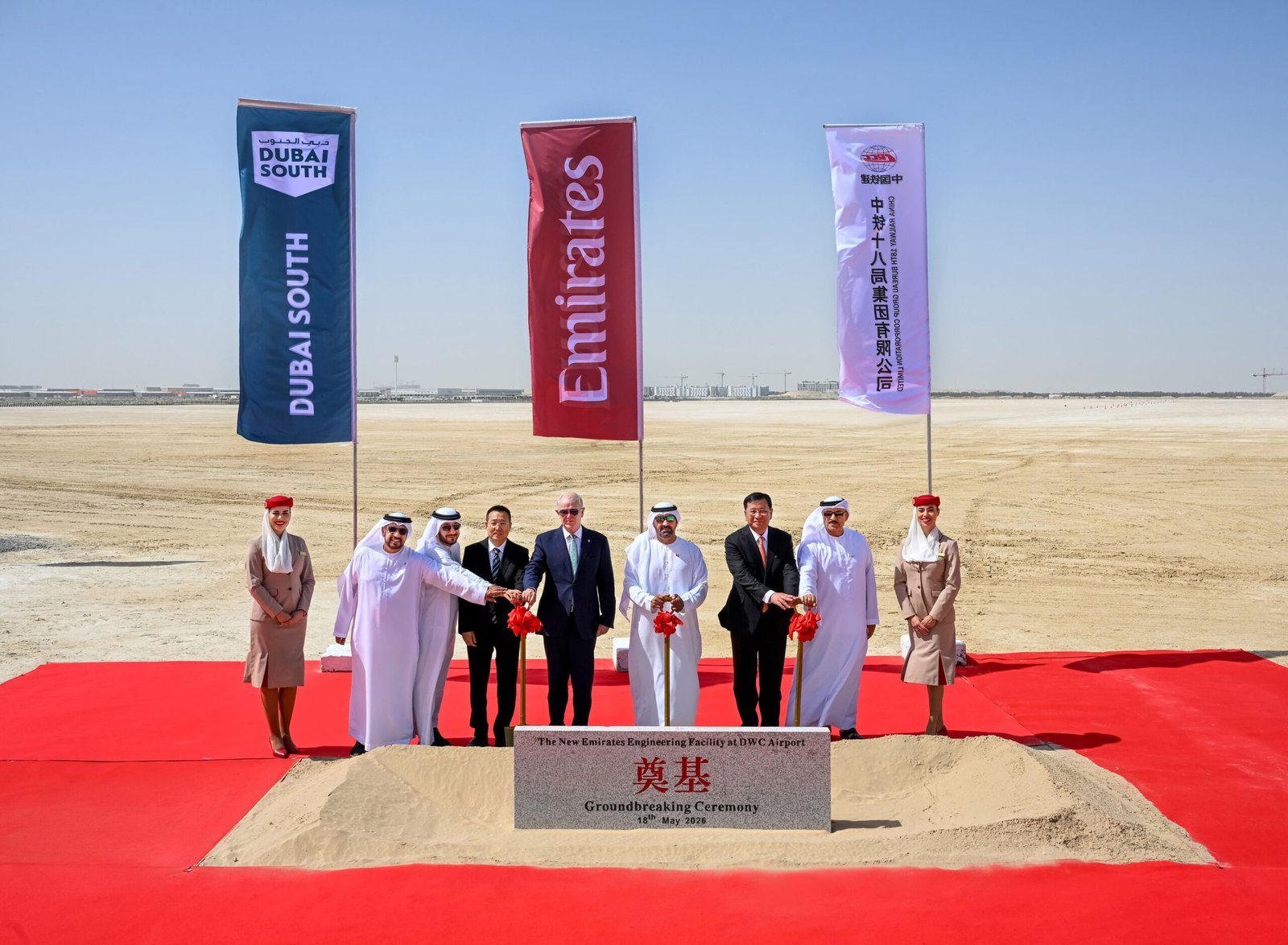
Emirates broke ground on a $5.1 billion engineering complex at Dubai South. Construction is being delivered by China Railway Construction Corporation. Completion is targeted for mid-2030. The facility will span 1.1 million square metres, which makes it one of the largest buildings in the world by volume and the largest steel structure in the GCC.
That headline travelled well. What did not travel as widely is the operational detail, and that detail is what matters if you are weighing Dubai South as a property allocation.
What was announced
The new facility will house Emirates' maintenance, repairs and overhaul (MRO) operation. It is engineered to service 28 wide-body aircraft at the same time, more than any hangar complex in the world. Two paint hangars will sit alongside it. The site will host the largest free-span hangar globally at 285 metres wide, and the largest dedicated landing gear workshop ever built.
It is being built at Dubai South, next to Al Maktoum International Airport. The site will absorb work currently handled at Emirates Engineering Centre at Dubai International Airport (DXB), and it will support the long-planned migration of Emirates' full operation from DXB to Al Maktoum.
The complex is targeting LEED Platinum certification. Solar panels across the roofs. Sheikh Ahmed bin Saeed Al Maktoum called it a strategic step forward in Dubai's aviation ambitions, and the project is being positioned by Dubai Aviation City Corporation as a benchmark for the future of global MRO.
Why this matters more than the dollar figure
A $5.1 billion building does not move property prices. Buildings do not buy or rent apartments. People do. The signal in this announcement is about people, and about which direction Dubai's labour market is moving.
Emirates already employs 12,000 cabin crew and tens of thousands of ground staff. The new facility brings mechanics, engineers, technicians, supply chain specialists, training staff, and administrators on top of that base. Industry estimates put the additional direct headcount in the thousands once the site is operational. Indirect employment, the suppliers and contractors and service businesses that grow around large infrastructure assets, typically runs three to four times the direct figure.
That is what an investor is actually buying when they buy in Dubai South in 2026. Not the airport. Not the engineering complex. A claim on the housing demand those buildings will generate when the people inside them need somewhere to live.
How Dubai South is already responding
The numbers tell you the market is not waiting for 2030. Residential transactions in Dubai South were up 30% year on year in 2025 compared to 2024. Property transactions in the area exceeded AED 15 billion in the first five months of 2025, nearly equalling the AED 16.1 billion recorded for all of 2024. Rents on one and two bedroom apartments in Dubai South and the neighbouring Dubai Investment Park rose roughly 20% over the trailing twelve months, driven largely by aviation and logistics workers moving closer to their work sites.
Dubai South Properties recently awarded a AED 2 billion contract for the Hayat residential community, a 2,500-unit development directly adjacent to the airport. Construction begins in Q2 2026. Emaar South continues to deliver inventory, and Azizi, Sobha, and several mid-tier developers have active projects in the corridor.
Pricing is still considerably below central Dubai. Properties in Dubai South typically transact at AED 750 to 850 per square foot. Comparable inventory in Downtown Dubai or Business Bay sits at AED 2,000 and above. That gap is not a quality discount. It is a timing discount, and it narrows as infrastructure delivers.
What this fits and what it does not
Not every investor should look at Dubai South. The Emirates announcement reinforces a story that was already in motion, but the story has a particular shape. It is long-dated. It is infrastructure-led. It rewards patience and punishes anyone trying to flip in eighteen months. Here is how I would think about who this fits.
What you cannot predict, and what you can
I cannot tell you whether Dubai South prices will appreciate 15% or 40% by 2032. Neither can anyone else. The variables are infrastructure delivery timing, broader regional macro, currency strength, oil prices, regulatory shifts, and how aggressively developers add supply between now and then. Honest analysts model ranges, not point estimates.
What is knowable is structural. The Al Maktoum airport expansion is funded, approved, and under active construction. Emirates' move to Al Maktoum is committed at the leadership level and the timing is public. The engineering complex is now contracted and breaking ground. Hayat is contracted. Expo City is operating. The metro extension is in planning. The 15-minute city framework is being built into every new master plan in the corridor.
You are not betting on whether these things happen. You are betting on the rate at which they happen and how the market prices them along the way. That is a meaningfully different bet than speculating on a single off-plan project in a less anchored area.
The risks worth naming
- Delivery delay. Mid-2030 is the stated completion target for the engineering complex. Mega-projects of this scale routinely run 12 to 24 months late. A two-year slip pushes the operational employment uplift to 2032 or later, which is meaningful for anyone counting on rental demand inflation in the late 2020s.
- Supply absorption. Hayat alone is 2,500 units. Emaar South, Azizi Venice, Pulse Residence, and the broader Dubai South pipeline together represent tens of thousands of units coming to market between now and 2030. If absorption lags supply in any single quarter, rents and prices will compress.
- Macro shock. Dubai property is sensitive to GCC oil revenue, global expat sentiment, and regional geopolitics. None of those are controllable. They are also not unique to Dubai South.
- Quality dispersion. Not all Dubai South developers are equal. Tier-one (Emaar, Sobha, Dubai South Properties direct) tend to deliver on time and at quality. Mid-tier delivery has been less consistent. The wrong developer can turn a good thesis into a bad personal outcome.
None of these risks negate the thesis. They define the discipline you need to apply when underwriting any individual purchase.
How I would act on this if I were starting today
I would not chase the news. The price reaction to the Emirates announcement has already started in the most exposed pockets, and chasing means paying the early premium for someone else's information. What works better is to use the announcement as confirmation, not as a catalyst.
If you already believed the Dubai South thesis, this strengthens it. If you did not, one announcement should not change that. Look at the underlying ten-year capital plan for the corridor, look at your own time horizon, and match them honestly.
For investors who decide to allocate, the questions worth answering before you commit capital are these: which sub-district inside Dubai South suits the strategy, which developer has the cleanest delivery record for the unit type you want, and what does your exit look like if the timeline slips by 18 months.
Those are the conversations worth having, and they are the conversations I have with clients every week.